Binance
What a $2,500 Crypto Trade Actually Costs You
In a simplified $2,500 example, trading fees on the buy and the sale come to $5, while a 2% card processing fee is $50. Spread and slippage never appear as a line item, so compare what you paid with what you received on each route in and out.
For a simplified example, assume both a buy and a later sale have an executed value of $2,500 and each is charged 0.100%. That is $2.50 per execution, or $5 in trading fees for the pair. Real round trips rarely sell at exactly the value they bought, so work each fill out on its own.
Now put the rest of the receipt next to it. If you funded the account with a debit card and the confirmation screen quoted a 2% processing fee, that line alone is $50 — ten times both trading fees combined, paid before you owned anything. Add the gap between the buy price and the sell price that exists even when the market has not moved. Add a withdrawal fee to get your dollars back to the bank, and a network fee if you moved coins on-chain at any point.
Compare the complete amount paid and received instead of assuming the trading commission is the main cost.
The fee printed on the confirmation
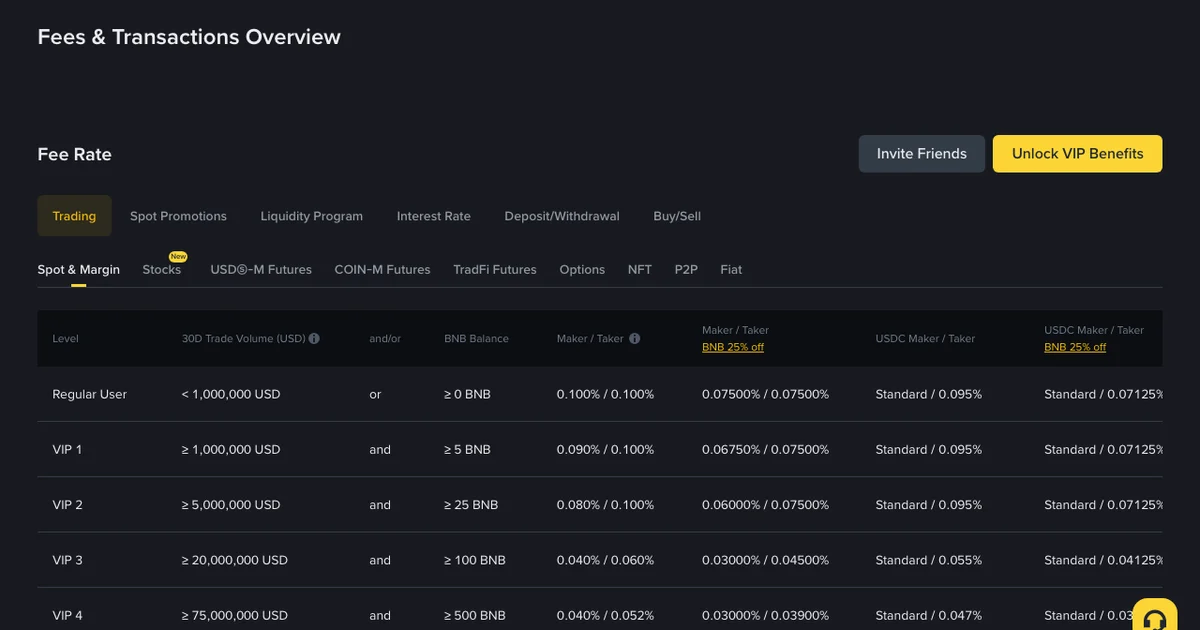
Spot trading fees are charged as a percentage of the trade value. Binance's published base rate is 0.100% for both maker and taker orders — one dollar on a thousand. The rate drops by 25%, to 0.075%, when you switch on the option to pay fees with BNB and hold enough BNB; the discount applies only while both are true. Those were the rates on the official fee page in September 2026. Fee schedules change, so treat fee numbers quoted in articles as a rough guide and open the current fee page for the exact figure.
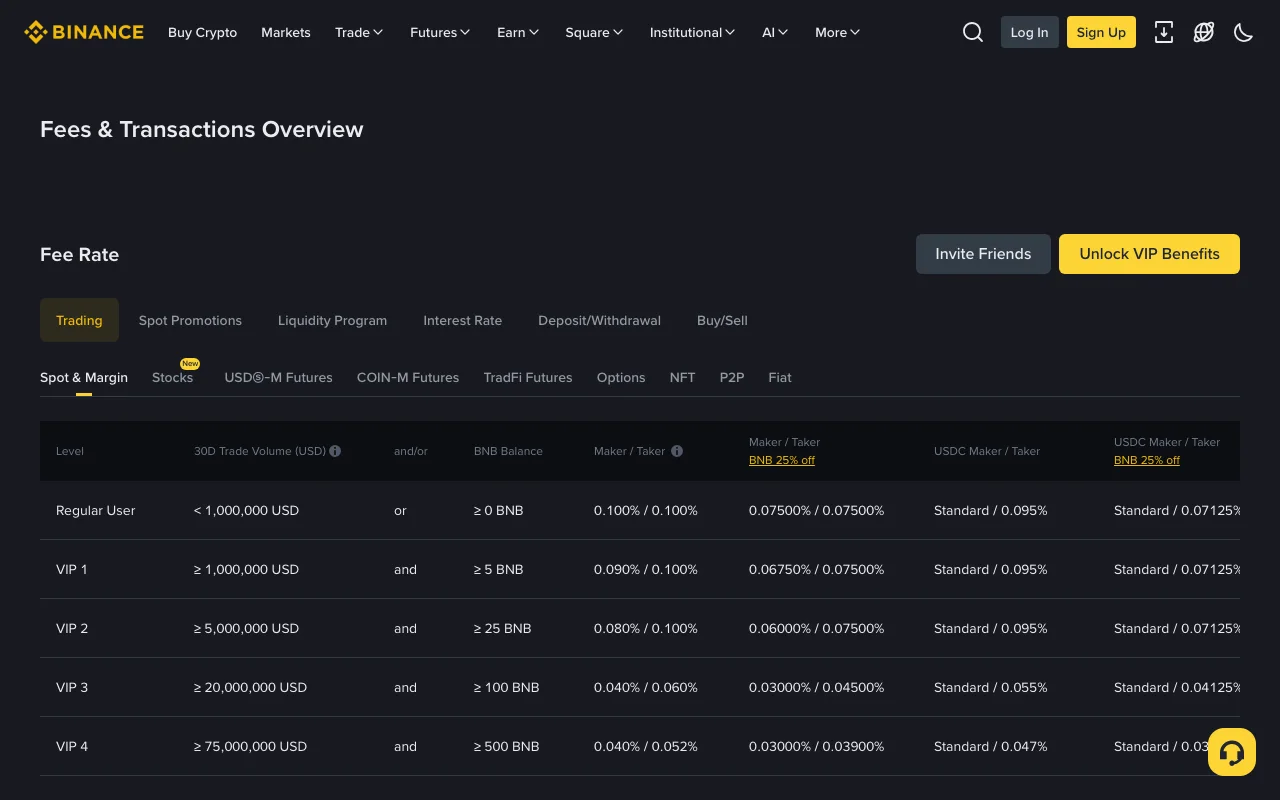
Binance's spot fee table as published on 23 September 2026. Screenshot from binance.com/en/fee/trading, not logged in.
Account tiers may depend on trading volume and holdings. Use your actual fee preview; do not trade more or hold an extra asset simply to reach a lower rate.
Maker, taker, and why anyone cares
A taker execution matches an existing order and removes liquidity; a maker execution comes from an order that first rests on the book. A limit order can execute immediately as a taker, or split into maker and taker fills. Binance explains the distinction here.
Exchanges usually charge makers less because a deep order book is what makes an exchange useful. On Binance's base tier both sides are 0.100%, so at beginner size the distinction is theoretical. It becomes real once you are trading often enough for a hundredth of a percent to compound. Learning to place limit orders has better reasons behind it — control over your fill price — than shaving a fee that is already tiny.
The costs with no line item
The spread is the gap between the best bid and best ask. With unchanged prices and no fees or slippage, buying and immediately selling the same quantity crosses one full spread. Its size depends on the pair and available liquidity, not just how well-known the coin is.
Slippage is the difference between the price you saw and the price you got. Your order eats the available offers from cheapest upward, and if the book is shallow, a moderately sized market order pushes through several price levels. The number you clicked on and the average price you paid are not the same number, and nobody sends you a notice about it.
A thin order book can make execution costs larger than commission. To check a “no-fee” quote, compare the total price for the same quantity and direction with another executable quote at a similar time.
Getting money in
Which payment methods you are offered depends on your residence, exchange and provider. To compare them, put two figures side by side for each route: the amount of crypto that actually lands in your account, and the total you paid to get it, with every fee and conversion included.
Bank transfer and card payment may have different fees, foreign-exchange costs, processing times and withdrawal holds. Read the provider’s estimate and the final confirmation page. A card issuer may apply additional charges under its own terms, and funds from a card payment may be held for a period before you can withdraw them.
Keep the payment confirmation and any bank or card charge with your trading record, so the same expense is not counted twice.
Getting money out
Cashing out to a bank and withdrawing crypto are charged differently.
For a bank withdrawal, check which channel is available, its fee, currency conversion, minimum and expected processing time. An earlier deposit does not guarantee that the same route works in reverse.
For a crypto withdrawal, the exchange quotes a withdrawal charge for the selected asset and network. With USDT the charge varies widely from one network to another, so it pays to choose the network for a USDT withdrawal with care. That charge is not necessarily the same amount as the network transaction cost it pays. Check the charge and net amount on the withdrawal confirmation page, rather than using a blockchain gas estimate as your bill.
First confirm that the recipient supports the asset and network, and verify the full address and any required memo. For a new route, a small test can help, but it also costs money. It must meet the sender’s withdrawal minimum and leave enough after fees to meet the recipient’s deposit minimum. If it does not arrive, stop and investigate instead of sending more. Binance’s withdrawal guide explains the on-screen checks; address verification remains necessary for each transfer.
The whole bill in one place
| Cost | Size, or what to check |
|---|---|
| Deposit by bank transfer | Check provider fees, conversion, processing time and holds |
| Deposit by card | Check the quoted processing fee and any issuer charges |
| Buy fee | 0.100% base, 0.075% with the BNB discount |
| Sell fee | Same |
| Spread | Compare the current best bid and ask for the chosen pair |
| Slippage | Depends on order size against book depth |
| On-chain withdrawal | Check the exchange’s fee, minimum and net amount for that network |
More transactions can add more fees and execution costs. With unchanged bid and ask prices, ten immediate buy/sell round trips cross ten full spreads, while twenty executions can incur twenty commissions. Slippage and market movement are separate. Fees and execution costs are only part of profit or loss; changes in the asset price matter too.
Keep original transaction records, including the fee amount and charged asset. Whether and how fees affect tax calculations depends on your jurisdiction and transaction type; check your tax authority’s guidance rather than applying a generic cost-basis rule.
Our own conflict of interest
This site earns referral commission from exchanges. Two things to be clear about.
This site does not charge you a separate fee for using its referral links. Binance's Referral Pro FAQ explains that the referrer receives a commission from the trading fees paid by the referred user on Spot, Margin and Futures trading. A referral link does not change the rates published on the fee page. Whether you get any saving at all, and in what form, depends on the programme behind the link, and some links give invitees nothing — under Referral Pro, there is a share for invitees only if the referrer fixed one when creating it. Check the sign-up page, the programme terms and your account's fee records rather than assuming the total cost stays the same.
Our Binance code is BN68L (sign-up page) and our OKX code is OK0012 (sign-up page). If you have not opened an account yet, the eligibility check comes first, and the verification steps are covered separately.
Getting the arithmetic right saves you money on the way in and out. It does nothing about being wrong on the thing you bought.