Getting Started
Buying Your First Crypto: Start With Whether You're Allowed To
Where you live decides which exchange entity can serve you, what you may trade and how money moves in and out. This guide covers Binance.com versus Binance.US, OKX's regional entities, why a VPN doesn't change eligibility, bank versus card deposits and where your coins sit afterwards.
Open the exchange's terms of use and find the restricted-countries list. Do that before you pick a password, before you photograph your passport, before you move a single dollar.
Where you live comes first because it can end the process on its own. If the exchange doesn't serve your country, the password, the passport photo and the deposit are all wasted effort.
Can you open an account where you live?
Start with the two exchanges beginners hear about first.
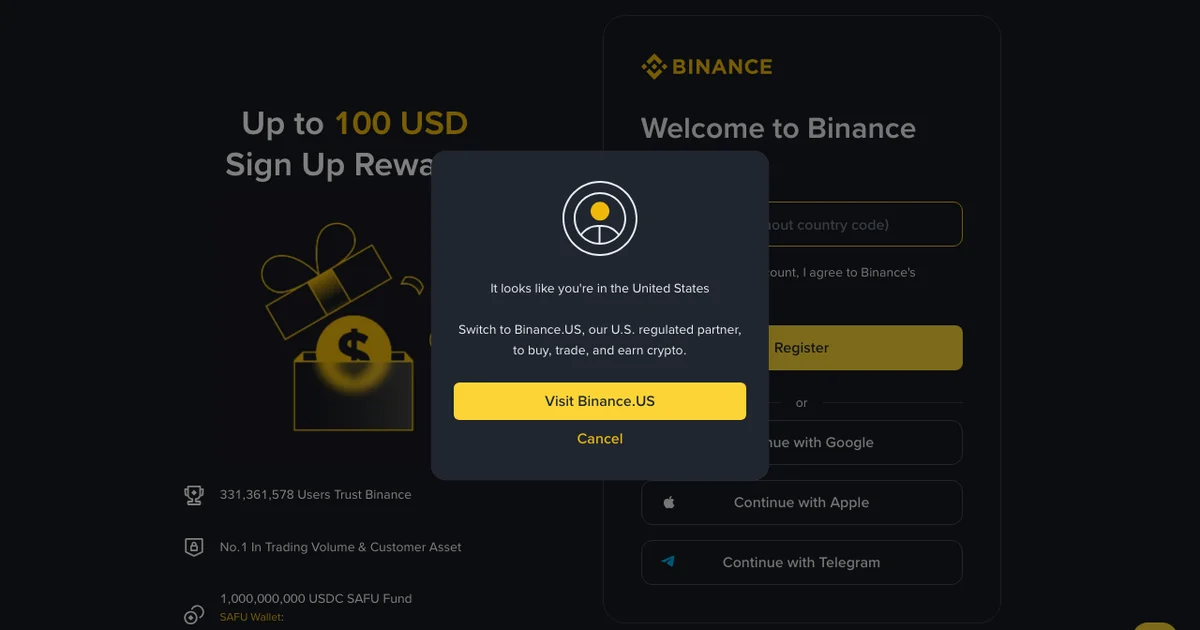
Binance.com, the international site, does not serve users in the United States. If you are a US resident, your route is Binance.US, and that is a separate company: its own entity, its own order book, its own listings, and a much shorter product menu. An account on one does not exist on the other. Binance.US is also still unavailable in some states, so a US address on its own is not enough.
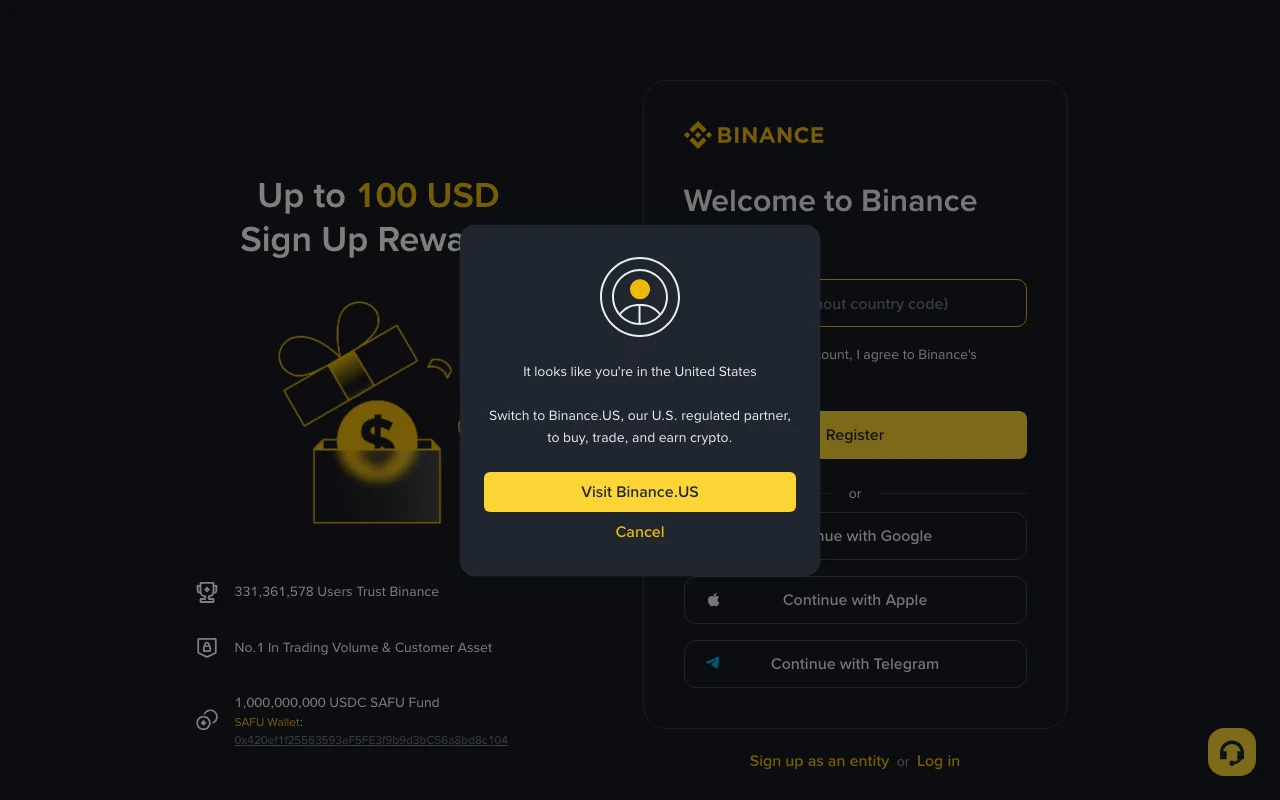
What binance.com showed when the sign-up page was opened from a US connection. Screenshot from binance.com, 23 September 2026, not logged in.
Binance has previously withdrawn services from Canada and the Netherlands, but old announcements like those are not a live country list; what counts is where things stand when you sign up. In the UK and EU, what you can use depends on local rules and on which company serves you there. Under the FCA rules, firms may not sell, distribute or promote crypto derivatives to UK retail clients, which tells you nothing either way about whether a given platform will open an account for you or offer you spot.
OKX serves eligible US customers through OKX US under US-specific terms and disclosures, with services restricted by state. Its global risk disclosure lists restrictions by location and by product, so being allowed to register doesn't mean the whole global menu is open to you.
In Australia, OKX Australia Pty Ltd provides digital currency exchange services. OKX Australia Financial Pty Ltd (AFSL 379035) issues derivatives and margin products. Its Australian guide allows eligible retail clients selected derivatives with up to 2x leverage, subject to local eligibility checks.
Every list here moves. Licences get granted, restricted and withdrawn, and a page written in 2026 is a starting point rather than an authority. Read the exchange's own terms of use and restricted-jurisdictions page on the day you sign up.
What happens if you use a VPN to get around it?
A VPN changes where your connection appears to come from. It changes neither your eligibility for an account nor what your identity documents say.
If a platform doesn't serve the place you live, don't misstate your residence or borrow someone else's documents to get through. A location mismatch can bring requests for information or restrictions on the account, and money you have deposited can sit frozen while it is reviewed. Stop that registration and look for a service that is legally available to you, rather than depositing money to see whether the restriction gets enforced.
What to have ready before you start
Put these on the desk before the first screen:
- An email address and a phone number you control. Verification codes and later account recovery run through them.
- An identity document the verification flow accepts, valid and undamaged. Which documents count varies by country, so check the list shown for yours.
- Personal details that match where you actually live — the residence you select, the address you type and the document should tell the same story.
- A way to secure the login, such as an authenticator app or passkey, set up before any money arrives.
Getting money in
The two main routes are bank transfer and card payment. Cards are usually faster and cost more; bank transfers are usually slower and cheaper. Don't decide by the method's name, though. On the confirmation screen, compare what you pay with what lands in the account, and look for currency conversion and any hold on withdrawing what you buy.
If the route is new to you, keep the first amount modest and look at minimums, fees and holds before paying. The cost breakdown explains what to compare.
Keeping the first trade simple
Understand the product before placing an order. Spot you buy with your own money can fall in value, but the exchange will not force-sell it the way it liquidates a leveraged position.
Futures and perpetuals are contracts, and they can bring leverage, margin requirements, funding charges and liquidation with them. You can lose the entire margin and, depending on how the account is set up, other funds in it as well.
For a first buy, the order type decides who picks the price. A limit order lets you name the most you will pay; a market order takes what is on offer, and on a thin pair that can be noticeably worse than the number you saw. Look at order size against available liquidity, even on widely traded coins.
Where the coins sit afterwards
By default, they stay in the exchange account. That is convenient, and it means the exchange holds the keys. You have a balance on their system rather than an asset you control.
Whether to leave them there comes down to what the money is for, how much it is, how far you trust the platform, and whether you can back up and recover a wallet yourself. Two-factor authentication cuts some account risks, but it doesn't make leaving coins on an exchange safe on its own. Moving them to your own wallet shifts the risk onto you. Losing the phone the wallet was on isn't the end while you still have a valid way to restore it, and MetaMask’s recovery guide shows where that line sits. Lose every way back in — the private key, the recovery phrase and any other valid recovery option — and a conventional self-custody wallet usually cannot be restored by anyone. Go by the instructions for the wallet you actually use.
Is any of this reportable?
Possibly, depending on where you live. Selling, swapping one coin for another, and spending crypto are treated as reportable events in a number of jurisdictions, and the rules differ enough that generic internet advice is worse than none. Check what your own tax authority publishes.
For now, keep your own note of each transaction as you make it: date, amount, price paid, fee. Exchanges do provide exports, but accounts get closed and products get discontinued, and your own notes stay with you when that happens.
What this guide leaves out
Nothing here says what to buy or when. We do not answer those questions, and we would treat anyone confidently answering them for free as a warning sign — several of the approaches that separate beginners from their money start exactly there. Once you have picked a platform, the sign-up and verification detail is a separate job. Whichever platform it is, treat the money you put in as money you might not get back.
Disclosure: we earn referral commission when readers sign up through our links to Binance's international site (invite code BN68L) and OKX (invite code OK0012). We receive nothing from Binance.US, which operates separately for eligible US residents — so if you are in the US, our Binance link earns us nothing and does nothing for you. On Binance's own description, a referrer's commission is a share of the trading fees the invited user has already paid. Whether any fee discount comes back to you depends on the referral programme behind the link and how it was set up — under Binance's Referral Pro, for instance, only if the referrer chose to share part of the commission when creating the link. Go by the sign-up page and your account terms.
Related guides
- Signing up for OKX — if OKX is the one that will serve you