Binance
Binance Sign-Up: Eligibility, Verification and Account Security
Check Binance's prohibited-countries list first, then register on a domain you typed yourself, add a passkey or authenticator rather than relying on SMS alone, read the stated reason if verification is rejected, and turn on the withdrawal whitelist before your first purchase.
Before you fill in a single form, settle one question: will Binance serve you where you live, and offer the product you want there? Registration, identity checks and account security all come after that, and none of them helps if the answer is no.
Where our money comes from: this site earns referral commission from Binance. That is our income, and you should factor it into how much weight you give our recommendation. Our code is BN68L and the sign-up page is here. Binance's referral FAQ describes that commission as part of the trading fees you pay, passed to the referrer. Any fee cashback for you depends on which referral programme the code belongs to: with Referral Pro, the referrer sets the share for invitees when creating the link and cannot change it afterwards. The sign-up page and your account terms are what count.
Check that Binance will serve you at all
Binance’s international service and Binance.US are separate, each with its own terms and products. If you live in the US, you need a service that accepts your state as well as your country, and this walkthrough doesn't cover Binance.US; our international referral link won't get you there either.
Old announcements about individual countries won't tell you where things stand today. The current source is the List of Prohibited Countries that Binance's Terms of Use refer to, plus the rules for the product you want, which are a separate matter: the FCA rule that bars firms from selling, distributing or promoting crypto derivatives to UK retail clients limits products, not whether an exchange accepts your account.
The eligibility checks go through this in more detail. Don't use a VPN or false residence details to get around a restriction, and don't count on an account staying usable just because registration went through; it may not last as far as your first withdrawal.
Type the domain yourself
The domain is binance.com. Fake versions rank in search results and buy ad slots above the real listing, on addresses that are one character off (sometimes a Unicode character that passes for a normal letter at small sizes) or that end in something other than .com. Enter your email, password and two-factor code on one of them, and someone else uses all three within seconds.
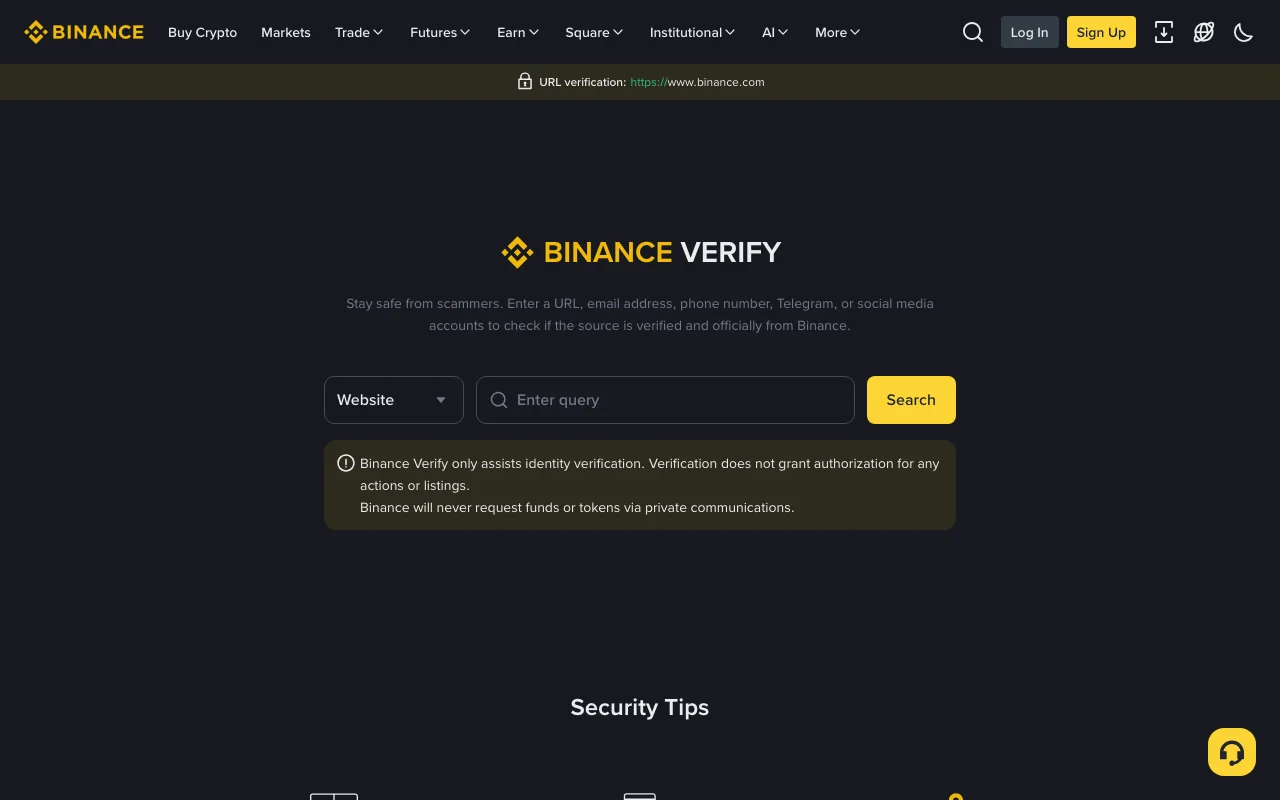
Binance Verify checks whether a website, email address, phone number or social media account is officially from Binance. Screenshot from binance.com, 23 September 2026, not logged in.
Type the address into the bar yourself, then bookmark it and use the bookmark from then on. Don't open exchange links people send you, including ours — if you would rather not trust a referral link, type binance.com manually and find the sign-up page yourself. The account works the same way.
Register and protect your account
The form wants an email address or phone number, a verification code and a password. Use an email you will still control in three years; recovery and withdrawal confirmations run through it, and a disposable address becomes a disaster on the day you need to get back in.
Then, before you deposit anything, sort out the following in one sitting.
Add a passkey or an authenticator app if your account offers them, rather than relying on SMS alone; SMS codes can be taken over through SIM-swap or number-transfer fraud. If you do keep SMS, ask your carrier what protections it offers on your line, since carriers differ.
If setup gives you an authenticator recovery key, keep it offline somewhere safe, and find out how your authenticator app backs up or transfers codes before you change phones. Without either, you are left with the exchange’s official recovery process, and there is no set time for that.
Set the anti-phishing code so that genuine emails and text messages from Binance carry a phrase only you know. A message without it, or with the wrong one, goes straight to the suspicious pile; one with it still gets checked in the app you opened yourself before you act on it.
Check the verification request and any rejection reason
Verification may require an accepted identity document, a face check and additional information for your account or service. If it fails, read the stated reason first: image quality is only one possibility.
Follow the current Binance identity-verification instructions. Before you submit, make sure the document is accepted and still valid, every side it asks for is included, the text is clear with no glare across the document number and no cropped edges, and the name and details you typed match the document exactly.
If the rejection says the image is unclear, retake it with even light and a clean lens; the same photo in the same light may fail the same way. No photo will fix an expired or unsupported document, though. Mind any retry limit, and ask official support if the reason still isn't clear.
If the face check fails, make sure the app has camera permission, remove anything covering your face, clean the lens and follow the requested movements in even light. If it keeps failing after that, lighting may not be the cause at all, and official support is the next step.
Review times vary from case to case. If yours has been sitting for longer than the official page says it should, open a ticket through the support entry inside the app, with your submission time and account email. Ignore direct messages offering to speed up the review, and check any request through the support entry you opened yourself; impersonating support is a common scam pattern.
Verification comes in levels that set your trading and withdrawal limits; fiat services may ask for extra checks on top. The thresholds change with regulatory requirements, so go by the numbers on your own account page rather than anything an article tells you.
Check funding options before moving money
Which funding methods you get, how long they take and whether funds are held all vary with your residence, the provider and your account. The confirmation page is where to compare them: the final amount credited, the fees, the currency conversion and any withdrawal restriction. Bank transfers are not always free, and money paid in by card isn't necessarily withdrawable straight away. If you buy through P2P, the USDT may land in an account the spot market can't draw on; Funding Account vs Spot Account after a P2P purchase explains where it goes and how to move it.
Keep the first purchase on the spot market; futures bring margin and liquidation into the picture, and the glossary explains the difference. Read the order preview and fee information before you confirm.
Binance's base spot fee is 0.100% for both maker and taker orders, and holding BNB with the fee discount switched on takes 25% off, which works out to 0.075%, but only if the switch is actually on and you hold enough BNB. Those were the published rates in September 2026, and the fee schedule changes, so read the current fee page. The visible fee is also not the whole bill.
After registration, before your first purchase
Turn on the withdrawal address whitelist so withdrawals can only go to addresses you have saved, then switch on the separate whitelist security restriction, which blocks withdrawals to a newly added address for the period you choose. Someone who gets past your security checks can still add an address; the restriction only buys you time to notice. Read every address in full before saving it.
Confirm the anti-phishing code is set and that you remember what you chose.
Start a record of every transaction from the first one — date, amount, price, fee. Your local tax authority may treat sales and swaps as reportable, and the rules vary by country; look up what yours publishes rather than trusting a forum. Reconstructing a year of trades afterwards is unpleasant.
A verified Binance account can sit empty for as long as you like. If the order screen, the fee page or the withdrawal conditions still leave you guessing, leave it empty until they don't.
- The OKX sign-up flow, for comparison — regional eligibility and the verification options to check